A company can close its books on the eighth working day, circulate a polished management pack on the tenth and still be operating with remarkably little control.
The accounts may reconcile. The commentary may explain every major variance. The board may receive a clear bridge from budget to actual. Yet none of this changes the fact that the decisions behind those numbers were made weeks earlier.
The materials were already purchased. The labour was already consumed. The customer discount was already accepted. The project overrun had already occurred. The invoice had already been delayed. The cash commitment was already unavoidable.
The organisation has explained the result accurately, but too late to influence it.
The month-end close should confirm the result—not reveal it for the first time.
This is not a criticism of accounting. Double-entry bookkeeping became one of the most durable management technologies because merchants needed control over capital, debt, ownership and profit. Periodic closing also made sense in a world of paper invoices, manual ledgers, physical stock counts and slow information flows. Monthly and annual reporting were rational compromises between accuracy, effort and available processing capacity.
The business environment changed. The compromise did not. Orders are accepted instantly, prices move quickly, supply chains span continents and customer behaviour can change before finance finishes reconciling the previous period. ERP, banking, CRM, payroll, inventory and project systems already generate data continuously, yet many companies still collect that evidence during the month, process much of it after the month ends and call the result management information.
The practical alternative is not to abolish month-end accounting. Companies still need cut-off, reconciliations, professional judgement, audit trails and reliable financial statements. The alternative is to maintain the financial position continuously and connect operational events directly to their cash and margin consequences.
That requires two connected capabilities: continuous accounting, which keeps the financial baseline current, and Event-to-Margin (E2M), which turns live operational activity into short-term cash, cost and margin intelligence.
The month-end problem is created during the month
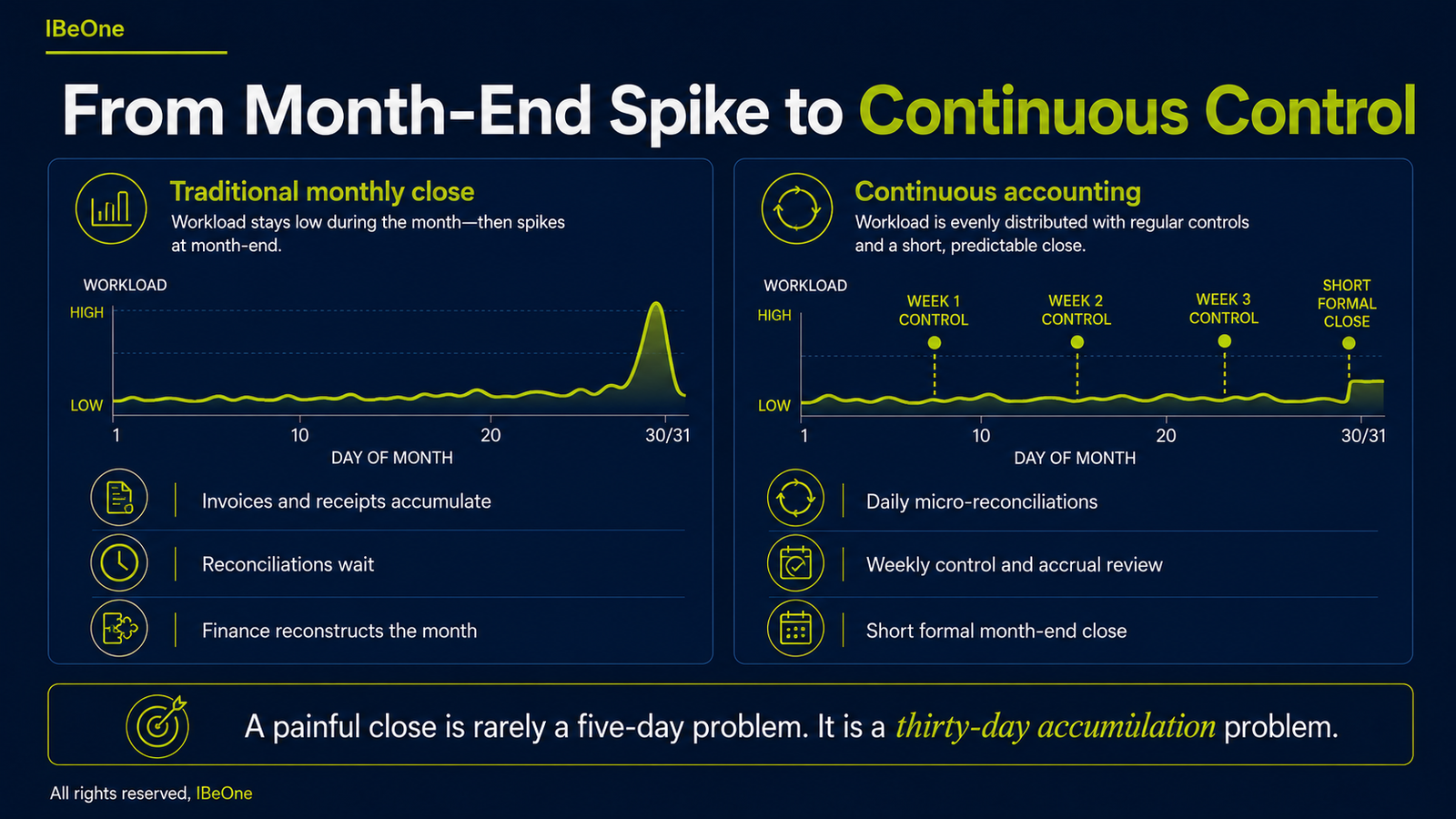
A difficult close is rarely caused by an unusually challenging final week. It is normally the accumulated consequence of thirty days of incomplete evidence and deferred control.
Supplier invoices arrive through different channels. Receipts remain with employees. Goods are delivered but not recorded promptly. Purchase orders are changed by email. Timesheets are completed late. Customer discounts are agreed outside the CRM. Project costs are coded into broad expense categories. Work is completed but not invoiced. Bank transactions remain unmatched because payment references are inconsistent.
Finance eventually resolves most of these issues. That is why the final accounts can still be accurate. But accuracy is achieved through reconstruction: searching inboxes, contacting managers, reviewing spreadsheets, estimating missing costs and correcting coding.
The visible cost is the time required to close. The less visible cost is what happens while the information remains unresolved. Customer invoices go out late. Supplier credits are missed. Duplicate payments survive longer. Unbilled liabilities remain hidden. Project margins appear healthier than they are. Cash forecasts begin from incomplete balances.
There is also a human cost. A finance team that spends the closing period repairing transactions has limited capacity left for analysis, challenge, scenario modelling or commercial support. The workload consumes not only hours, but concentration and working memory.
Automatic accounting begins outside the ERP
Many finance transformations begin with the wrong question: Which system will automate our accounting?
A better question is: Does the business consistently produce the evidence required for automation?
An ERP can process a complete invoice. It cannot process an invoice that was never submitted. It can match a goods receipt to a purchase order, but it cannot recognise goods that arrived without a recorded receipt. It can assign labour cost to a project, but it cannot recover a timesheet completed three weeks late. It can apply a pricing rule, but it cannot understand a discount agreed informally between a salesperson and a customer.
In most organisations, the hardest reconciliation problems are not created inside the accounting platform. They are created upstream, where commercial and operational events occur. The ERP receives the consequence.
The dream of automatic accounting therefore does not rest on a perfect ERP or one exceptional implementation specialist. It rests on preparing an environment in which events are complete, structured and recognisable.
The business must define when a material event has occurred, capture evidence close to the source, maintain stable data standards and assign responsibility to the people who create the event. Live businesses will always change—prices move, scopes evolve, orders are cancelled and customers dispute terms—but each material change needs a reason, an effective date, an owner, an approval and a visible financial consequence.
Automation does not require a static business. It requires controlled change.
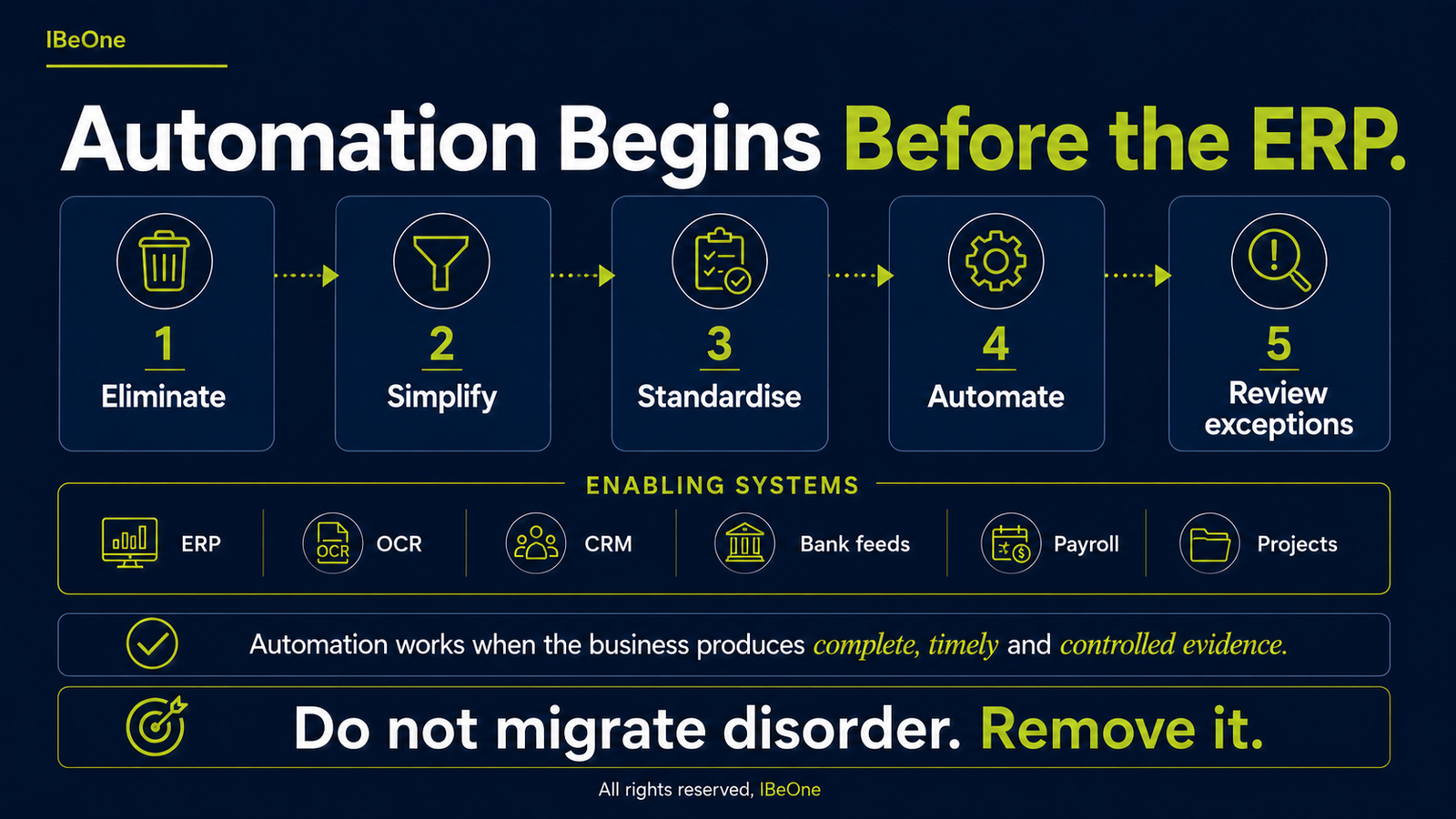
Optimise before automating
When closing is slow, management often assumes the company needs a new ERP, more integrations or a larger finance team. Sometimes it does. But a new platform can inherit the same disorder as the old one.
If invoices still arrive through five different channels, the new system will receive them late. If project teams still fail to record labour, the new system will still calculate the wrong margin. If purchase commitments remain informal, the new system will still underestimate short-term cash requirements.
The better sequence is to eliminate unnecessary work, simplify the remaining process, standardise the stable parts and automate only when the rule is reliable. Activities involving unusual contracts, material estimates, provisions or revenue recognition may remain under professional review. Automation is not superior merely because it is possible.
The objective is optimisation: the required speed, accuracy and control at the lowest total economic cost. In some areas that means full automation. In others, a semi-automated workflow with visible exceptions is stronger and cheaper.
What continuous accounting looks like in practice
Continuous accounting does not mean formally closing every account every day. It means reducing unresolved uncertainty throughout the period.
When a transaction occurs, the evidence is captured at source. Supplier documents enter through a controlled digital channel and OCR extracts the basic fields. Employees submit expenses immediately. Goods receipts are recorded on arrival. Time is assigned to projects daily. Customer milestones trigger invoicing when the contractual condition is met.
Every morning, bank and card data are imported automatically. Stable rules match routine receipts, payments, subscriptions, payroll clearing and internal transfers. Finance does not inspect every normal transaction manually; it reviews an exception queue prioritised by value, age, cash impact and control risk.
A short daily review resolves what can be resolved and assigns the remainder to a named owner. Each week, finance reviews the items that require judgement rather than simple matching: overdue receivables, unbilled liabilities, project costs, accruals, prepayments, inventory anomalies, missing timesheets and material margin movements.
Recurring costs are scheduled rather than rediscovered. Rent, insurance, payroll, depreciation, leases, financing costs and predictable accruals are distributed across the period for management purposes. The statutory books may retain monthly posting conventions where appropriate, but the management view no longer pretends that these costs disappear for twenty-nine days and suddenly exist at month-end.
Month-end then becomes shorter and calmer. The team completes cut-off, reviews material estimates, confirms reconciliations and approves the period. It does not begin from a pile of unresolved transactions.
Continuous accounting keeps the baseline current. Event-to-Margin makes it commercially useful.
Event-to-Margin: from operational event to financial consequence
Consider a medium-sized engineering business delivering customer projects. It accepts an order worth £180,000. The original estimate assumes £70,000 of materials, £45,000 of direct labour and £20,000 of subcontracted work. The expected contribution before allocated overhead is £45,000.
Under a conventional process, the project margin develops quietly in the background. Purchase orders are raised. Materials arrive. Labour is recorded. Supplier invoices follow later, sometimes in the next reporting period. The full financial picture becomes clear only when finance closes the month and reconciles project costs.
Under E2M, the financial position changes as the operating events occur.
When the purchase order is approved, the company records a commitment. It knows the expected supplier cost, required delivery date and likely cash outflow. When materials arrive, the goods-received event confirms that the cost has economically entered the business. Even if the invoice has not yet arrived, the system can recognise an unbilled liability, assign the cost to the project and update the forecast margin.
When project labour is approved, hours and labour rates update the consumed project cost. When a supplier increases the price of a remaining component, cost-to-complete changes immediately. When a delay adds another week of labour, the system updates expected margin and cash timing.
The accounting consequence does not wait for the final document.
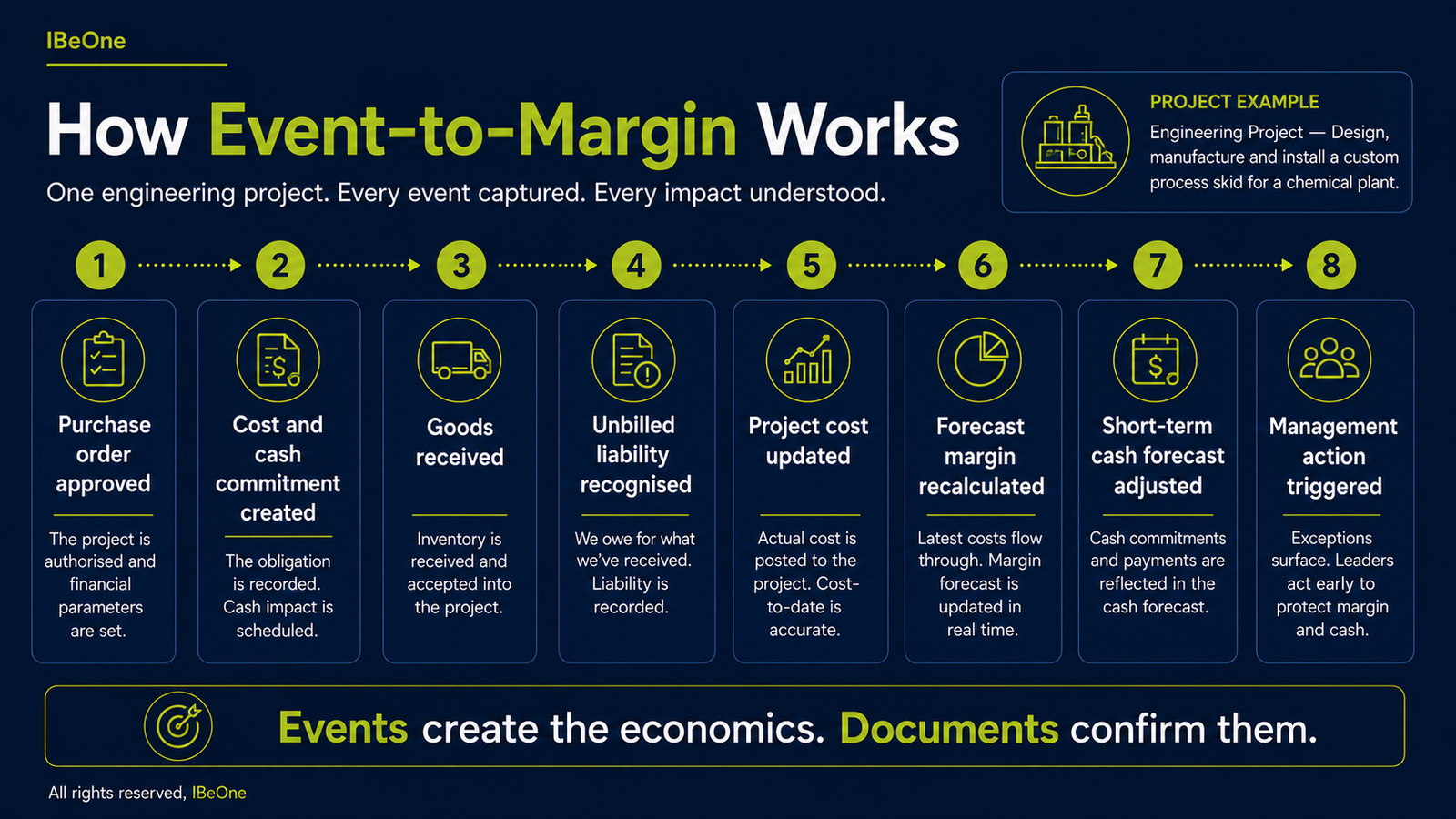
The method requires each material event to be connected to an economic object. A transaction still needs a ledger account, but that is not enough. It must also be assigned to the relevant customer, product, service, project, job, order, contract, location or process.
This does not mean creating thousands of accounts. It means creating a better economic map. A broad entry called “materials” tells management what was spent. A mapped event tells management which project consumed the material, whether the cost was planned, when the supplier must be paid and whether the customer price remains profitable.
The baseline must be current
A two-to-ten-day forecast cannot be reliable if its starting position is already several days behind. The company needs a substantially current view of reconciled cash, open receivables, expected collections, approved payables, purchase commitments, goods received but not invoiced, payroll, tax, recurring costs, project labour, material consumption and known exceptions.
Uncertainty does not need to disappear completely. That would be unrealistic. It needs to be visible. Management should distinguish what is confirmed, what is estimated and what remains unresolved. A current estimate with clear assumptions can be more useful than a final number delivered after the action window has closed.
You cannot forecast seven days ahead when the starting position is already three days behind.
Cash and margin are different forecasts
The engineering company may have enough cash to pay suppliers this week while simultaneously producing work below its required margin. It may also have a profitable project and still face a temporary liquidity problem because the customer will pay after payroll and material suppliers fall due.
E2M therefore needs two connected but separate views.
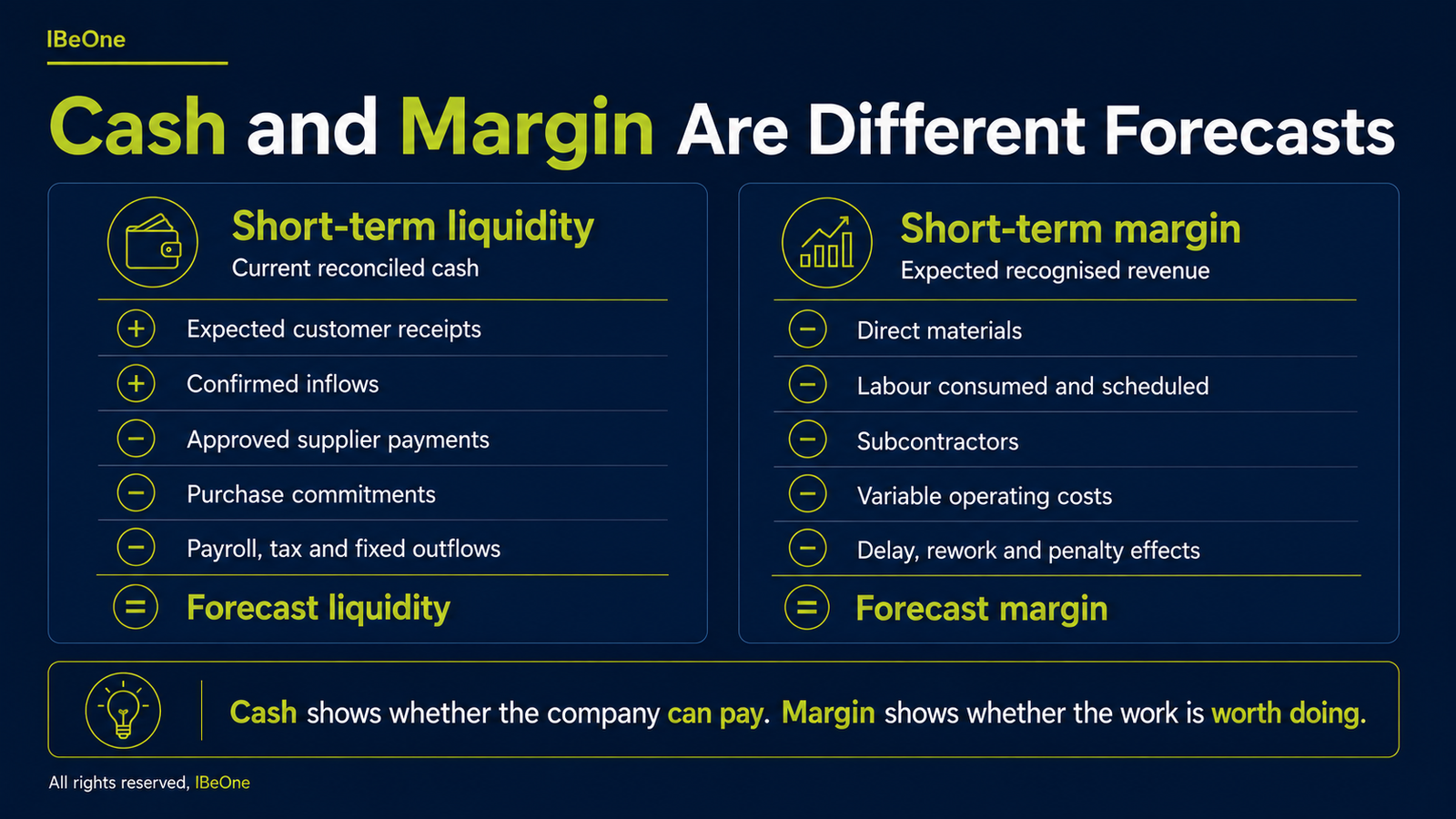
Expected receipts should not rely only on invoice due dates. The model should also consider customer payment history, current disputes, promised payment dates and collection probability. Margin should be visible by the object management can act upon: customer, product, project, job, order or service.
Why the two-to-ten-day horizon matters
Long-range forecasting remains necessary for planning, financing and strategy. The short horizon serves a different purpose.
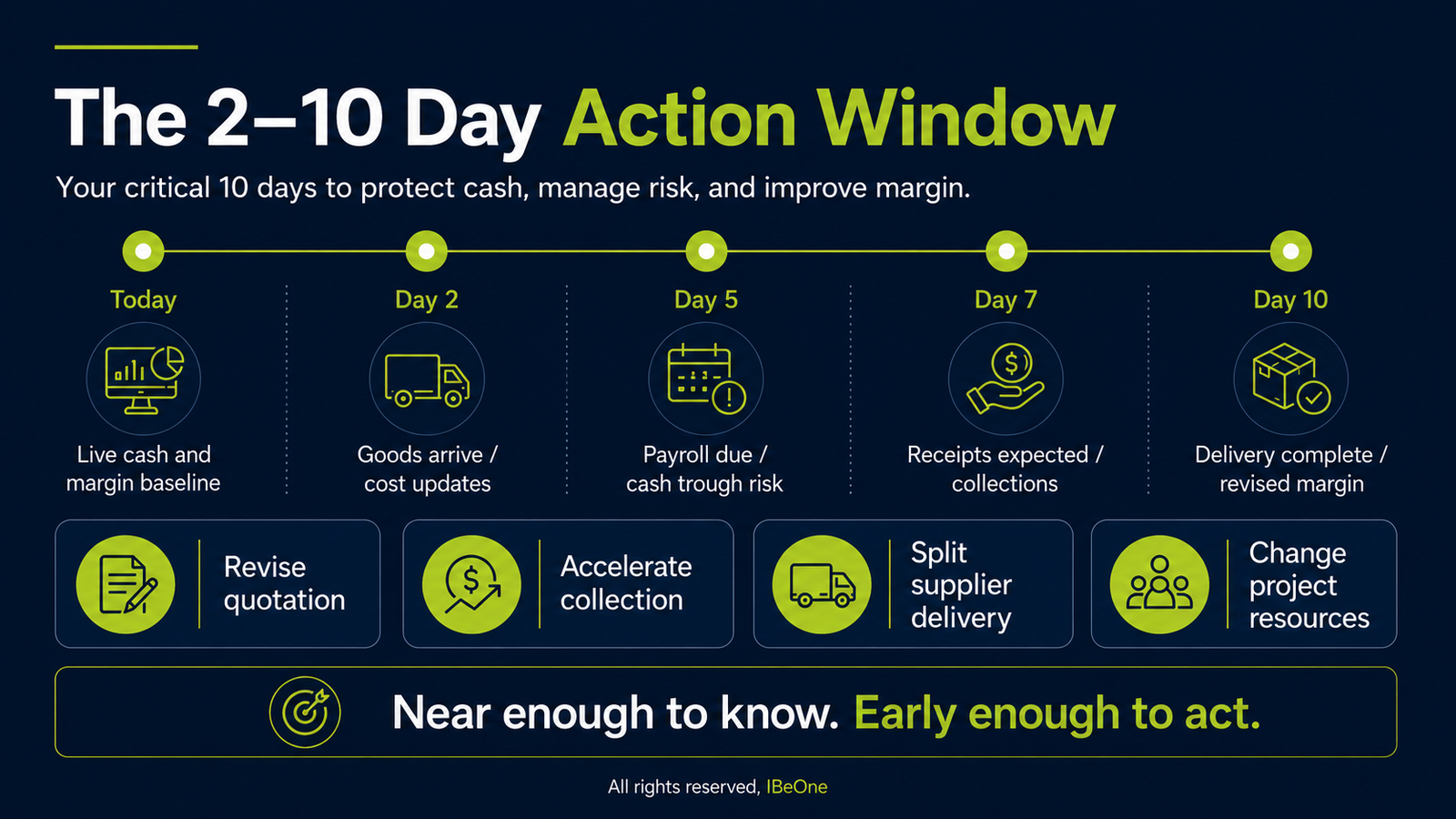
Over the next two to ten days, many important facts are already visible. Orders are known. Deliveries are scheduled. Payroll dates are fixed. Purchase commitments exist. Customer invoices are open. Project work is in progress.
The forecast is close enough to current operations to be credible and early enough for management to respond. A supplier price increase can change a quotation before the next order is accepted. A cash trough on Day 5 can trigger collection activity on Day 1. A labour overrun can be interrupted before the project is completed.
How short-term forecasting creates money
Return to the engineering project. The first material delivery is more expensive than expected. The E2M model shows that the project remains profitable, but the same price cannot be used for the next quotation without reducing margin below the company’s threshold. Sales adjusts the quotation before the next order is accepted.
That is margin protection.
The liquidity forecast then shows a cash trough on Day 5. A large customer payment is expected on Day 7, but payroll and a material payment fall earlier. Finance identifies the issue on Day 1. The company resolves a customer invoice query, accelerates part of the collection and negotiates a split supplier delivery.
That is cash protection.
Later, project labour begins to exceed the expected run rate. The issue is visible before the job is complete. Operations changes the resource mix and raises a contractual variation for additional customer work.
That is loss prevention.
None of these actions requires a perfect forecast. They require a sufficiently current position, a short decision window and a visible connection between the event and its economic consequence. The value does not come from a more attractive dashboard. It comes from changing a decision before the loss or cash pressure becomes unavoidable.
A practical fourteen-day pilot
A company should not attempt to convert its entire finance architecture at once. A focused pilot can begin with one business unit, one project type, one bank account or one important transaction stream.
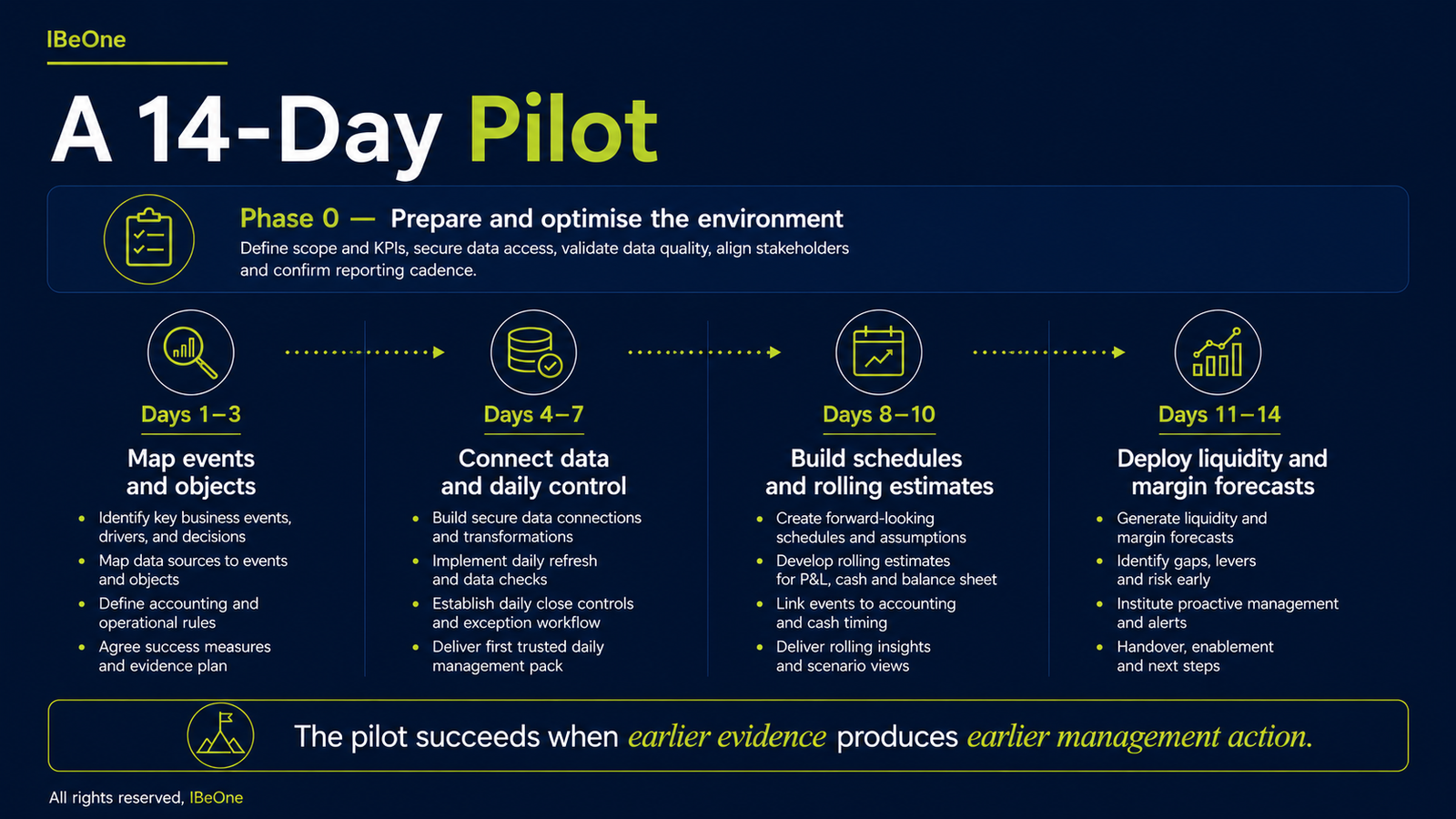
Phase 0 prepares the environment. Identify where documents go missing, where reconciliation differences recur, where ownership is unclear and which activities should be eliminated, simplified, standardised, automated or retained under professional review.
Days 1–3 map events and objects. Select the principal events—purchase orders, goods receipts, timesheets, sales orders, deliveries, invoices and customer receipts—and map each to its ledger account, customer, project, product, expected cash date, margin category and responsible owner.
Days 4–7 connect data and daily control. Activate bank, OCR, CRM, expense, payroll and operational feeds where practical. Define matching rules and establish a daily exception review for material unresolved items.
Days 8–10 build schedules and rolling estimates. Create recurring schedules for payroll, rent, insurance, depreciation, prepayments and stable accruals. Introduce unbilled-cost estimates and current project-cost updates.
Days 11–14 deploy the short-term views. Connect current cash, receivables, payables, purchase commitments, payroll, recurring costs and project margins. Produce two-, five-, seven- and ten-day liquidity and margin forecasts, together with exception owners and potential actions.
The pilot should then be measured through operational and commercial outcomes: the number and value of unreconciled items, missing documents, unbilled revenue, forecast error, finance hours spent chasing evidence, cash collected earlier and margin protected.
The migration is successful only when earlier accounting evidence produces earlier management action.
The old close still has a purpose
Continuous accounting does not make the month-end close unnecessary. It changes its role.
The formal close still confirms the accounting position, applies judgement, validates cut-off and supports reporting, audit and compliance. But it no longer serves as the company’s first serious attempt to understand the month.
The rearview mirror remains essential. It shows where the business has been and confirms whether the record is reliable. It should not be the principal instrument used to navigate what happens next.
Continuous accounting keeps the financial position current. Event-to-Margin connects that position to the operating events that create cash, cost and value. Short-horizon forecasting gives management enough time to change a quotation, collect cash, renegotiate a purchase or interrupt a project loss.
The company still closes its books. It simply stops waiting for the close to understand its business.
The old close explains the month. Event-to-Margin helps manage the next ten days.